How a Math Problem Illustrates Arizona Solar System’s Unique Needs
(Don’t worry, we do the math for you— and it works in your favor!)
Arizona residents and business owners don’t need anyone telling them that Arizona summers are extreme.
If you experienced the massive heat wave that hit the Western U.S. in the summer of 2017, it won’t come as a surprise that year was the warmest year on record for Tucson, Arizona.
In fact, the last four years have been the hottest on record for Tucson since record keeping began. So what does Arizona’s extreme weather have to do with a math problem?
It starts with understanding that solar PV (photovoltaic) systems performance, as an electrical system, is directly impacted by heat. So while all solar panels have an efficiency rating that measures their ability to convert sunlight to electricity, they also have a temperature coefficient that rates how well they perform in high heat.
In the equation (and real life!), the temperature coefficient is the multiplier for estimating how well the solar panel will produce under different temperatures.
You see solar panels are rated in watts similar to a light bulb or other electrical devices. However, the watt rating of solar panels are determined under Standard Test Conditions (STC). Therefore, a 300-watt panel is 300 W DC STC. This implies the panel is receiving 1000 watts of sun per square meter, and that the temperature is 25 degrees Celsius, or 77 degrees Fahrenheit.
Now, if we were to place that panel on a roof in Tucson in mid-July, the output probably wouldn’t really be 300 watts.The same can be said for other regions, but this is particularly important in Arizona because we deal with such high heat in the summers. It’s especially important to be aware of this so you can get optimal solar panel performance in Tucson and Southern Arizona.
So how much should a 300 watt panel produce when it’s over 100° Fahrenheit outside, and closer to 160 degrees Fahrenheit on the panels?
Let’s say the panel is 120 degrees Fahrenheit, or 43 degrees above test conditions levels of 77 degrees F. If the temperature coefficient is -.258, then we would do the following math equation:
In this example, the panel will produce about 257 watts, a significantly different number than just reading the wattage would indicate .
The temperature coefficient is an important piece of the puzzle when considering what solar panels to purchase. And like we said, you don’t have to do the math. Just remember that the lower the number for the temperature coefficient, the better!
Panasonic Solar photovoltaic panels have the world-record best temperature coefficient for solar panels, making them the ideal choice for Southern Arizona solar buyers who want the best return on investment for their system.
Want to know more about how making the right selections for your home or business solar installation can help you get the best return for your money? Call Sunbright Solar at 520-222-9993 for a free expert consultation.
When it comes to solar power systems, it’s easy to get overwhelmed by information. But if you gloss over some details, you’ll be selling yourself short. Solar panels’ efficiency ratings and temperature coefficients both impact overall efficiency, and are one of those areas where knowledge is power.
Getting familiar with these distinctfactors can help you get the most bang for your buck when going solar!
Let’s start with the most common number you will see, the efficiency rating. This is the ability of the panel to convert sunlight into electricity. The rating is determined under Standard Test Conditions (STC) that measure the amount of energy the PV panel can convert to DC power when it is ‘flashed’ with precisely 1000 watts of light per square meter, under conditions consistently kept at 77° F. Sunbright Sidenote: Does 77 degrees sound nothing like the Arizona summers you’re familiar with? You’re right to be wary! Keep reading to understand how the temperature coefficient is important for Arizona solar panel installations.
Top-performing Panasonic solar panels have significant advantages
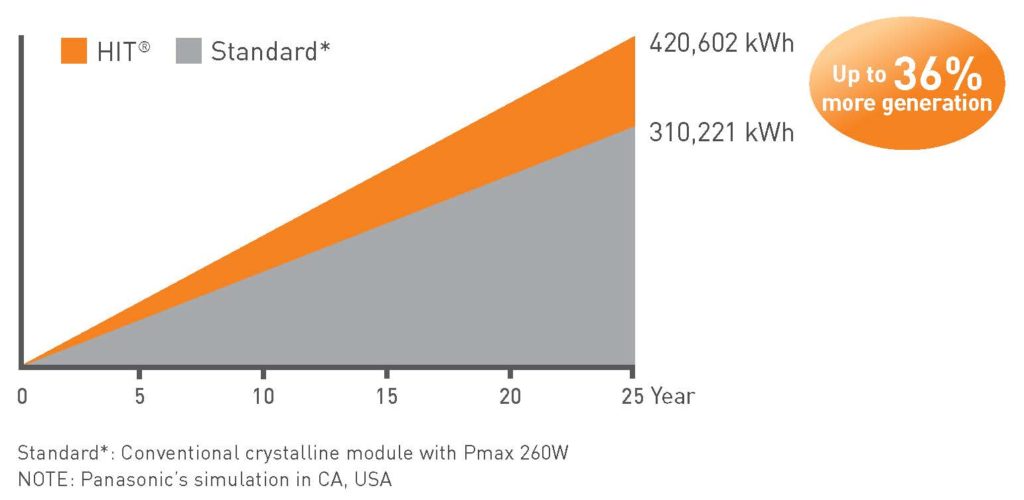
The range of efficiency ratings for typical residential and smaller commercial solar power installs is about 14-18%, with high-end panels at around 19-20%. Sunbright Sidenote: Panasonic’s HIT Solar Panels are at the very high end of the range, coming in at 18.5% to 20.3%. Sunbright Solar is Tucson’s only Panasonic Solar Premium Installer.
Stay tuned for our upcoming blog on how this status helps Sunbright provide the best benefits and the best price for your solar installation!
Other factors also directly impact your solar power system’s efficiency, and therefore your solar return-on-investment (ROI).
Let’s focus on other big factor impacting Arizonans the most, the temperature coefficient. All electrical systems, including solar power systems, share that they don’t perform as efficiently in high heat. While it may sound negative when first hearing it, this is actually a bonus for smart solar customers!
Tucson and Southern Arizona have abundant sunshine, and if you plan for the harsh summer temperatures, you can build a solar panel system with the best ROI, that pays for itself the fastest. Sunbright Sidenote: Panasonic’s HIT Solar Panels hold the world record for the lowest temperature coefficient (lowest is best!).
Bottom Line: Solar panels’ efficiency ratings and temperature coefficients have a large impact on your solar panel system’s overall return-on-investment. In Southern Arizona’s extreme summer temperatures, the temperature coefficient is possibly the most important specification to consider when deciding which solar panels will be the best investment.
Solar Power Trains. It sounds like something you might get from a toy store, right? Well, you can’t get this from the mall, but I assure you they are cooler than any gadget you can find at the Sharper Image.
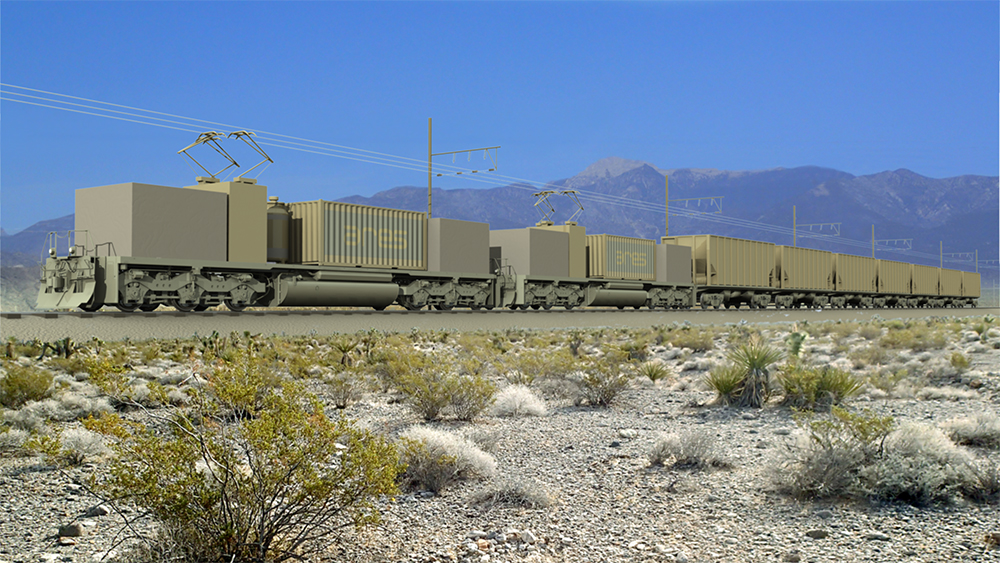
These power trains are not the same as electric trains or rail cars that run on electricity. Instead, they actually make power! They use the same principle as many hybrid cars do today, regenerative braking. Regenerative braking pairs with with gravity to create the power. This is the process of taking kinetic energy created by slowing the car or object, and converting it to electricity for use or for storage.
It works like this: during the night or when power use is low, the train will work its way up the mountain. Then, when power demand is high, the train will gradually roll back down the hill, creating on-demand electricity when it’s needed the most.
This concept of on-demand power for peak times has been around for a long time. In many parts of the country, we pump water to a high elevation reservoir and then let it flow back down through a turbine. However these trains have a leg up because they have a better response time for producing on-demand energy. This quicker response is only rivaled by batteries — which, by the way, the train is packed full of!
The first of its kind is being built in Nevada and will have the capability of producing 50 Mega Watts of power. Named ARES, or Advanced Rail Energy Storage, it will work over a 5.5-mile stretch known as the “Sisyphus Railroad.”
This is just one extraordinary example of what can be done with a combination of renewable energy power sources and battery energy storage. As we like to say at Sunbright Solar, the Future is Bright! Want to be part of the clean energy revolution, yourself? Give Sunbright Solar a call anytime — (520) 235-8133
Have you ever heard of such a thing? A “Negawatt” is the power we don’t use, but could be saved. It is real power that was generated, but never made its way home. It was simply lost in transmission…
Here’s how this happened: you see, we built our power grid on large, centralized power plants. If we needed more power, we built another plant. Then we built them bigger, made them further away, sometimes made them nuclear, and then followed that up with miles and miles of transmission lines. After all, nobody really wanted them in their backyard, and who can blame them? This was the norm, and at the time when most power was generated from coal and oil, it made sense.
However, today’s energy looks very different. We emphasize grid reliability and efficiency. We look to control rising costs at a time when demands have become greater. New generations are more and more plugged in through technology advancements, we power nearly every structure we build, and it’s looking like cars are up next.
So what does that have to do with a Negawatt? Well, for every mile electricity has to travel we get a little less out of it. So if we generate power close to home, we get more out of it. When we expand our grid with solar and wind, we get a more efficient and reliable power infrastructure. Power companies love this. They get to sell nearly 100% of your excess power to your neighbors at full cost and you get credit for future use. This concept might be a little crazy, but this is a real thing. It’s called net metering and it works like this: You add solar panels, pay a connection fee and taxes to the utility, and both you and the power company benefit from kicking the Negawatt! Try it…… You’ll save you Gigabucks! Want to learn more? Call Sunbright Solar Today! (520) 222-9993
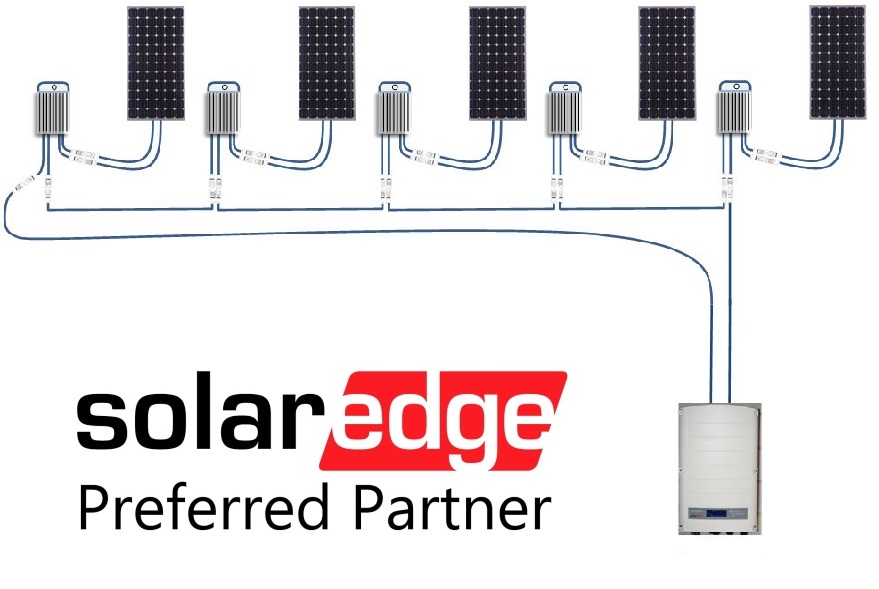
What are MLPE’s? Let’s start with a brief history.
At the beginning of widespread solar power adoption, there were two elements in a system: panels and string inverters. Panels were simply wired together to create an array. (more…)
Have you ever seen a solar-powered car? Me too…they do that race once a year where they see who can travel the fastest, “albeit at 20 mph,” called the American Solar Challenge. I hear the University of Michigan is pretty dominant. Now have you ever seen a solar-powered air conditioner? They exist, but are uncommon and don’t have a big payoff. The real point is, “Why don’t we see them more?” and “Why haven’t we seen solar AC?” Well, it’s the same reason we don’t see solar refrigerators: It’s not practical!
Why not?
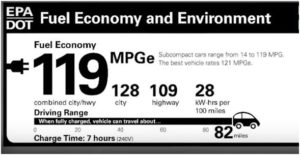
Well, solar power is meant to be harnessed and released like with a battery or utility grid. Think of it this way: We can’t guarantee a sunny day tomorrow, but where I live in Tucson, Arizona, we can guarantee about 200 of them a year. The most practical solution is to connect a big solar array to the home and to the grid, thus creating solar AC’s, solar refrigerators, and more importantly Solar Electric Cars. Once you see it through that lens we start seeing a lot more solar cars than we used to. Now I think that’s pretty cool in and of itself, but really that’s just the tip of the iceberg. This image below is of a window sticker from an EV Electric Vehicle. Note that in the acronym ‘MPGe,’ (e) is for equivalent.
It gives you a pretty good idea of the benefits that electricity has over gas power engines when it comes to efficiency, but since we’re on the topic, let’s put some dollar figures to this.
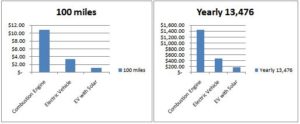
In a typical car or SUV these days, I’d say it’s fair to say we’re getting about 20 mpg or 5 gallons per 100 miles. Last time I filled up, gas was about 2.15 a gallon, making that 100-mile trek cost about $10.75 a pop. Now the average American drives 13,476 miles a year, leaving you with a yearly tab of $1448.67. Reduce the MPG to 15, and it’s $1931. But for argument’s sake, I’d say that about $1500 is probably low but a good round number.
Now let’s Look at the EV, (I think we’re looking at info from a Nissan Leaf). It says in order to travel 100 miles, it takes 28KW-hrs. Well, a kWh, or kilowatt-hour, costs about 11 – 15 cents depending on who your utility provider is. So, if we use 12 cents then 28X$.12= $3.36 per 100 miles and $452 per year.
Now let’s add solar into this equation. We know that utility power is 12 to 15 cents per kWh but solar allows for power to sold or produced at a much lower costs sometimes in the range of 3-5 cents per kWh. Thus making that 100-mile trip cost right about $1.12 using 4 cent average with an annual cost of about $151 and that is why I anticipate seeing a lot more solar-powered cars in the future. Who knows I might just see you in one.
Want to know more? Check this out! Want to check out going solar with an EV-ready Inverter? Call Sunbright Solar Today! — (520) 222-9993




Recent Comments